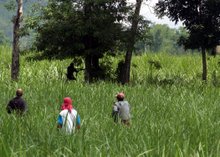
Some people say that in order to get freedom one has to give his/her life in exchange. The plight of the farmers in Hacienda Velez Malaga is a challenge to the present struggle for a genuine agrarian reform. From this experience one can see that the law does not all times hold the solution.
The farmers of Hacienda Velez Malaga tried to follow the law and the rules on Agrarian Reform. They rejected the easier path of taking arms. They went through the process of DAR , appeared before the Municipal Trial Court, the Regional Trial Court, Court of Appeals and the Supreme Court to answer the cases filed against them.
They underwent hunger strike in front of Quezon Circle and went back to Velez Malaga to start tilling the lands awarded to them. They never lose reason, they continued to claim what is due them according to the law and in a lawful manner. They ended up watering the land awarded to them with their blood. What else will they need to do to get their land?
The Rural Poor Solidarity, a gathering of Farmer’s Organizations and Non-Governmental Organizations aiming to attain genuine social justice through agrarian reform, salute Teresa Mameng, Pepito Santillan, Alejandro Garcesa and Ely Tupas, and those who still fight with their lives so that the landless tillers may have freedom from the bondage of hacienderos.
We continue to support the struggle of the remaining farmers for their full and immediate installation over the agrarian reform covered land. We condemn the government especially the DAR for delaying the implementation of the CARP exposing the farmer beneficiaries to more harasment and death. We condemn the state, the DAR in particular for failing to protect farmer beneficiaries.
The government is accountable to the injury and death that befell the farmers hoping to get their awarded land. The police and military must side with the helpless farmers rather than being used by big landowners in protecting their private interests. The police and military could have prevented the recent massacre in La Castellana if they heed this.
Finally, We vehemently condemn the landlords particularly Roberto Cuenca who continue to resist the CARP through legal and illegal means...They fail to realize that they are no longer the owners of the land and that it is a criminal act to hold on to big landholdings at the expense of landless tillers who suffer from poverty. We renew the call for full implementation of the CARP with strong political will and healthy participation from the peasant sector.
Saturday, June 9, 2007

Where are the heads that would roll?
“Where are the heads that will roll?”
This was the question posed by the peasant federation Task Force Mapalad (TFM) to Agrarian Reform Secretary Nasser Pangandaman after some 25 farmers from Hacienda Velez-Malaga entered on June 7 the Department of Agrarian Reform provincial office in Bacolod City to protest what they said was the refusal of DAR legal officer Vicky Delgado to demarcate the boundaries of the 53 hectares where they were installed last March 22.
TFM president Jose Rodito Angeles said the farmers were angered by Delgado’s refusal to order the conduct of demarcation unless she talked to Senior Supt. Pedro Merced, chief of the 6th Provincial Regional Mobile Group (PRMG), which was responsible for maintaining peace and preventing violence inside the hacienda, located in Barangay Robles, La Castellana, Negros Occidental.
Merced, however, was nowhere to be found. He had made himself scarce after the shooting incident last June 4 inside the hacienda in which three security guards of former landowner Roberto Cuenca fired at some 50 farmer-beneficiaries, killing two and wounding six.
The farmers, however, said there was no need for Delgado to wait for Merced because she could ask the Philippine Army contingent in the area to assist.
They also said that the two-and-a-half months delay in the conduct of the survey was already unreasonable.
“We feel that Attorney Delgado was giving us a run around. She is just using Merced to further delay the demarcation of our land,” said Gregorio Paclibar, 70, president of the organization of farmer-beneficiaries in Velez-Malaga.
Angeles said the protesting farmers will stay inside the compound of the DAR provincial office until the 53 hectares are demarcated and fenced.
“Pangandaman should now fulfill his earlier promise, announced in the media, that heads would roll in the DAR provincial office if he found that provincial DAR officials had delayed the survey that he ordered to determine the boundary of the land granted to the farmer-beneficiaries.
Angeles said that instead of obeying Pangandaman’s order to conduct survey, provincial agrarian reform officer (PARO) Stephen Leonidas entered into a negotiation with former landowner Roberto Cuenca for reimbursement of the expenses on standing crops.
“PARO Leonidas had used this negotiation to prevent the farmer-beneficiaries from entering their land and to delay the conduct of survey,” he said.
“What right did PARO Leonidas have to negotiate with Cuenca on the standing crops? Did he act on his own or was he ordered to negotiate? If so, who gave him the order?,” Angeles asked.
Angeles further said that Leonidas tried to strike a deal with Cuenca to relocate the farmer-benefiaries from the 53 hectares to another portion of the hacienda.
“What right did PARO Leonidas have to strike such kind of deal with Cuenca behind the back of the farmer-beneficiaries?,” he asked.
Angeles said there was no point in negotiating for the standing crops because Cuenca had been ordered by DAR three times to stop cultivation of the 114 hectares already awarded to the farmer-beneficiaries.
“PARO Leonidas himself wrote one of the letters ordering Cuenca to stop cultivation. The two other letters were written by former PARO Felicidad Bañares and current Undersecretary for Field Operations Narciso Nieto. That Cuenca continued to cultivate the land was a violation of the DAR orders. He does not deserve to be reimbursed for the standing crops. He should be charged for violation of the DAR orders,” he said.
He further said that Leonidas, by giving the farmer-beneficiaries a run-around in their demand for the conduct of demarcation survey, created the situation that led to the bloody incident last June 4.
Angeles said Leonidas went missing shortly after the June 4 shooting incident inside the hacienda in which two farmer-beneficiaries were killed and six others were wounded.
“Secretary Pangandaman should take some action against PARO Leonidas. He should show that he is still in control of his people at the DAR provincial office,” Angeles said.
This was the question posed by the peasant federation Task Force Mapalad (TFM) to Agrarian Reform Secretary Nasser Pangandaman after some 25 farmers from Hacienda Velez-Malaga entered on June 7 the Department of Agrarian Reform provincial office in Bacolod City to protest what they said was the refusal of DAR legal officer Vicky Delgado to demarcate the boundaries of the 53 hectares where they were installed last March 22.
TFM president Jose Rodito Angeles said the farmers were angered by Delgado’s refusal to order the conduct of demarcation unless she talked to Senior Supt. Pedro Merced, chief of the 6th Provincial Regional Mobile Group (PRMG), which was responsible for maintaining peace and preventing violence inside the hacienda, located in Barangay Robles, La Castellana, Negros Occidental.
Merced, however, was nowhere to be found. He had made himself scarce after the shooting incident last June 4 inside the hacienda in which three security guards of former landowner Roberto Cuenca fired at some 50 farmer-beneficiaries, killing two and wounding six.
The farmers, however, said there was no need for Delgado to wait for Merced because she could ask the Philippine Army contingent in the area to assist.
They also said that the two-and-a-half months delay in the conduct of the survey was already unreasonable.
“We feel that Attorney Delgado was giving us a run around. She is just using Merced to further delay the demarcation of our land,” said Gregorio Paclibar, 70, president of the organization of farmer-beneficiaries in Velez-Malaga.
Angeles said the protesting farmers will stay inside the compound of the DAR provincial office until the 53 hectares are demarcated and fenced.
“Pangandaman should now fulfill his earlier promise, announced in the media, that heads would roll in the DAR provincial office if he found that provincial DAR officials had delayed the survey that he ordered to determine the boundary of the land granted to the farmer-beneficiaries.
Angeles said that instead of obeying Pangandaman’s order to conduct survey, provincial agrarian reform officer (PARO) Stephen Leonidas entered into a negotiation with former landowner Roberto Cuenca for reimbursement of the expenses on standing crops.
“PARO Leonidas had used this negotiation to prevent the farmer-beneficiaries from entering their land and to delay the conduct of survey,” he said.
“What right did PARO Leonidas have to negotiate with Cuenca on the standing crops? Did he act on his own or was he ordered to negotiate? If so, who gave him the order?,” Angeles asked.
Angeles further said that Leonidas tried to strike a deal with Cuenca to relocate the farmer-benefiaries from the 53 hectares to another portion of the hacienda.
“What right did PARO Leonidas have to strike such kind of deal with Cuenca behind the back of the farmer-beneficiaries?,” he asked.
Angeles said there was no point in negotiating for the standing crops because Cuenca had been ordered by DAR three times to stop cultivation of the 114 hectares already awarded to the farmer-beneficiaries.
“PARO Leonidas himself wrote one of the letters ordering Cuenca to stop cultivation. The two other letters were written by former PARO Felicidad Bañares and current Undersecretary for Field Operations Narciso Nieto. That Cuenca continued to cultivate the land was a violation of the DAR orders. He does not deserve to be reimbursed for the standing crops. He should be charged for violation of the DAR orders,” he said.
He further said that Leonidas, by giving the farmer-beneficiaries a run-around in their demand for the conduct of demarcation survey, created the situation that led to the bloody incident last June 4.
Angeles said Leonidas went missing shortly after the June 4 shooting incident inside the hacienda in which two farmer-beneficiaries were killed and six others were wounded.
“Secretary Pangandaman should take some action against PARO Leonidas. He should show that he is still in control of his people at the DAR provincial office,” Angeles said.
Not illusion, but realization of dreams
Task Force Mapalad said on June 7 that the statement of the National Federation of Sugar Workers (NFSW) that TFM is sacrificing the lives of farmers by making them believe that land reform can be realized through the Comprehensive Agrarian Reform Program is unfortunate in the wake of growing incidents of agrarian-related killings all over the country.
“We are saddened that we are supposed to be organizations working for the betterment of the farmers yet they see us in a different light,” local TFM spokesperson said in response to statements of officials of the NFSW.
Days after the killing of two farmer-beneficiaries in Hacienda Velez-Malaga, an NFSW official said that while land is valuable, the lives of farmers should not be sacrificed. Another NFSW official said TFM is goading the farmers into occupying land in exchange for money from foreign-funding agencies.
“We have no illusion that CARP is a perfect program. It has its many defects, but we believe it is wrong to say that the farmers will gain nothing from it. On the contrary, despite the government’s lack of political will and the resistance of big landowners, it is the only program available at present that the farmers can use to assert their right to own land,” local TFM organizer Jerry Cahilig said.
Cahilig said that contrary to NFSW’s claim that the farmers are only given false hopes, TFM has made numerous successes that gave concrete reality to the farmers’ hopes to own land under CARP.
“In the cities of Talisay, Silay, Manapla, Cadiz , and Sagay, more than 2,800 hectares are currently being cultivated by more than 2,000 farmer beneficiaries. These lands are titled under their name,” he said.
“Once landless farmers have now become masters of their own destiny, I think that is not giving them illusions but actually making sure that they will realize their dreams,” Cahilig said.
Edna Sobrecaray, spokesperson of TFM Negros, said: “it is sad that instead of condemning Roberto ‘Bob’ Cuenca , the police, and the government for the murders of Ely Tupas and Alejandro Garcesa, NFSW deemed it fit to pick on us instead of those who are supposed to be held responsible for the continued oppression of the peasantry.”
Sobrecaray also said that it is unkind for NFSW to accuse TFM of sacrificing the lives of farmers for an alleged illusion.
“We assure the NFSW that the farmers have a mind of their own. They can clearly see if they are just being sacrificed for nothing. With all its years of experience in political struggle, NFSW should be the first to see that killings occur because of class resistance,” she said.
Cahilig added: “It is said that there are many ways to skin a cat. If NFSW wants to achieve land reform through other method, we respect it by all means. If they want CARP to be scrapped, we likewise respect that. What we want, on the other hand, is respect for our position and for the gains that we have achieved. We do not want to miss out on the many opportunities we see for the farmers under CARP just because it has lots of defects,” Cajilig said.
Sobrecaray further said: “CARP in itself is a political battleground. It is a way of educating the farmers in the struggle for land rights. When an administration fails to uphold their rights under CARP, then the farmers see concretely how morally bankrupt that administration is, and then they realize that they must strongly unite and wage a determined struggle for their rights. If we scrap CARP, it will make the big landowners very happy. We do not want to do that.”
“We are saddened that we are supposed to be organizations working for the betterment of the farmers yet they see us in a different light,” local TFM spokesperson said in response to statements of officials of the NFSW.
Days after the killing of two farmer-beneficiaries in Hacienda Velez-Malaga, an NFSW official said that while land is valuable, the lives of farmers should not be sacrificed. Another NFSW official said TFM is goading the farmers into occupying land in exchange for money from foreign-funding agencies.
“We have no illusion that CARP is a perfect program. It has its many defects, but we believe it is wrong to say that the farmers will gain nothing from it. On the contrary, despite the government’s lack of political will and the resistance of big landowners, it is the only program available at present that the farmers can use to assert their right to own land,” local TFM organizer Jerry Cahilig said.
Cahilig said that contrary to NFSW’s claim that the farmers are only given false hopes, TFM has made numerous successes that gave concrete reality to the farmers’ hopes to own land under CARP.
“In the cities of Talisay, Silay, Manapla, Cadiz , and Sagay, more than 2,800 hectares are currently being cultivated by more than 2,000 farmer beneficiaries. These lands are titled under their name,” he said.
“Once landless farmers have now become masters of their own destiny, I think that is not giving them illusions but actually making sure that they will realize their dreams,” Cahilig said.
Edna Sobrecaray, spokesperson of TFM Negros, said: “it is sad that instead of condemning Roberto ‘Bob’ Cuenca , the police, and the government for the murders of Ely Tupas and Alejandro Garcesa, NFSW deemed it fit to pick on us instead of those who are supposed to be held responsible for the continued oppression of the peasantry.”
Sobrecaray also said that it is unkind for NFSW to accuse TFM of sacrificing the lives of farmers for an alleged illusion.
“We assure the NFSW that the farmers have a mind of their own. They can clearly see if they are just being sacrificed for nothing. With all its years of experience in political struggle, NFSW should be the first to see that killings occur because of class resistance,” she said.
Cahilig added: “It is said that there are many ways to skin a cat. If NFSW wants to achieve land reform through other method, we respect it by all means. If they want CARP to be scrapped, we likewise respect that. What we want, on the other hand, is respect for our position and for the gains that we have achieved. We do not want to miss out on the many opportunities we see for the farmers under CARP just because it has lots of defects,” Cajilig said.
Sobrecaray further said: “CARP in itself is a political battleground. It is a way of educating the farmers in the struggle for land rights. When an administration fails to uphold their rights under CARP, then the farmers see concretely how morally bankrupt that administration is, and then they realize that they must strongly unite and wage a determined struggle for their rights. If we scrap CARP, it will make the big landowners very happy. We do not want to do that.”
Negros Farmers want regional police chief sacked
Task Force Mapalad farmers trooped on June 8 to the Philippine National Police headquarters in Camp Crame for an audience with PNP Director General Oscar Calderon to seek the relief of two Negros Occidental police officers—Senior Supt. Pedro Merced, chief of the 6th Provincial Regional Mobile Group (PRMG), and PO1 Rolly Padasas, detachment commander of the PRMG unit in Hacienda Velez-Malaga.
TFM president Jose Rodito Angeles said they are preparing administrative charges against Merced and Padasas for gross dereliction of duty and other acts of commission or omission that may have led to or aggravated the shooting incident last Monday in the disputed 446-hectare hacienda in Barangay Robles, La Castellana.
Two farmer-beneficiaries—Alejandro Garcesa, 70, and Ely Tupas, 51—were killed and six others were wounded after being fired upon at around 10 a.m. by three blue guards of the hacienda. The guards have not been arrested.
The farmer-beneficiaries said the shooting was unprovoked, contrary to an earlier claim by La Castellana Police Chief Regidor Alvarado that a heated argument ensued between the guards and the farmers.
“There was no heated argument. We went to Padasas at around 9:30 a.m. to tell him that we are going to enter our land and work. There were no security guards present,” said Florenda Hilario, 48, a farmer-beneficiary.
Angeles said they will also follow up with Camp Crame the complaint they filed against Merced in 2004 in connection with the death of 60-year-old Teresa Mameng in Hacienda Conchita Villanueva, Barangay Sag-ang, La Castellana.
Angeles said that at that time Merced was personally ordered by then PNP Director General Edgardo Aglipay to send in RMG troops to the hacienda after the farmers reported that followers of former landowner Mario Villanueva were planning an attack.
However, Merced did not send in any troops, and at around midnight of September 3, armed men came and strafed the houses of the farmer-beneficiaries.
Mameng was found dead the next morning in the corn field near her house, with a bullet wound on her chest.
In the case of Padasas, Angeles said that the PRMG detachment commander clearly neglected his duty to maintain peace and prevent occurrence of violence.
“They were stationed in the hacienda precisely to prevent any untoward incident, under whatever circumstances. Padasas not only failed to do that, he also initially refused to heed the farmers’ call for help,” said Angeles.
Elidylin Paclibar, 54, said that when the shooting occurred and two of their companions were hit, she and several women farmers went to Padasas to ask for help.
“I asked him, ‘Aren’t you going to do something? Two of our companions are already down,’” Paclibar said she told Padasas.
However, Padasas reportedly said, “What can we do? We are not your security guards,” to which Paclibar retorted, “Then why are you here?”
She said Padasas and the other policemen were merely laughing, prompting her companions to swear angrily at the policemen.
Paclibar said that when the Philippine Army contingent arrived at around 11:30 and fired warning shots to stop the security guards from shooting, it was only then that Padasas made a move to intervene.
TFM counsel Rudy Gabasan of the Ateneo de Manila University-based Saligan lawyers group said they will file appropriate complaints before the Office of the Ombudsman and the National Police Commission.
Gabasan said they are gathering and evaluating testimonies from witnesses to build cases against the RMG police officers.
TFM president Jose Rodito Angeles said they are preparing administrative charges against Merced and Padasas for gross dereliction of duty and other acts of commission or omission that may have led to or aggravated the shooting incident last Monday in the disputed 446-hectare hacienda in Barangay Robles, La Castellana.
Two farmer-beneficiaries—Alejandro Garcesa, 70, and Ely Tupas, 51—were killed and six others were wounded after being fired upon at around 10 a.m. by three blue guards of the hacienda. The guards have not been arrested.
The farmer-beneficiaries said the shooting was unprovoked, contrary to an earlier claim by La Castellana Police Chief Regidor Alvarado that a heated argument ensued between the guards and the farmers.
“There was no heated argument. We went to Padasas at around 9:30 a.m. to tell him that we are going to enter our land and work. There were no security guards present,” said Florenda Hilario, 48, a farmer-beneficiary.
Angeles said they will also follow up with Camp Crame the complaint they filed against Merced in 2004 in connection with the death of 60-year-old Teresa Mameng in Hacienda Conchita Villanueva, Barangay Sag-ang, La Castellana.
Angeles said that at that time Merced was personally ordered by then PNP Director General Edgardo Aglipay to send in RMG troops to the hacienda after the farmers reported that followers of former landowner Mario Villanueva were planning an attack.
However, Merced did not send in any troops, and at around midnight of September 3, armed men came and strafed the houses of the farmer-beneficiaries.
Mameng was found dead the next morning in the corn field near her house, with a bullet wound on her chest.
In the case of Padasas, Angeles said that the PRMG detachment commander clearly neglected his duty to maintain peace and prevent occurrence of violence.
“They were stationed in the hacienda precisely to prevent any untoward incident, under whatever circumstances. Padasas not only failed to do that, he also initially refused to heed the farmers’ call for help,” said Angeles.
Elidylin Paclibar, 54, said that when the shooting occurred and two of their companions were hit, she and several women farmers went to Padasas to ask for help.
“I asked him, ‘Aren’t you going to do something? Two of our companions are already down,’” Paclibar said she told Padasas.
However, Padasas reportedly said, “What can we do? We are not your security guards,” to which Paclibar retorted, “Then why are you here?”
She said Padasas and the other policemen were merely laughing, prompting her companions to swear angrily at the policemen.
Paclibar said that when the Philippine Army contingent arrived at around 11:30 and fired warning shots to stop the security guards from shooting, it was only then that Padasas made a move to intervene.
TFM counsel Rudy Gabasan of the Ateneo de Manila University-based Saligan lawyers group said they will file appropriate complaints before the Office of the Ombudsman and the National Police Commission.
Gabasan said they are gathering and evaluating testimonies from witnesses to build cases against the RMG police officers.
'The police merely watched as Cuenca's goons shot at us'
Task Force Mapalad (TFM) on June 6 belied reports that a heated argument between farmer-beneficiaries and security guards of Hacienda Velez-Malaga in La Castellana, Negros Occidental ensued prior to the shooting last Monday that left two farmer-beneficiaries killed and six others wounded.
TFM president Jose Rodito Angeles said the farmer-beneficiaries, numbering about a hundred, were working on the 5-hectare portion of the hacienda when three security guards of former landowner Roberto Cuenca took position behind trees and started firing their shotguns.
Killed in the shooting were Alejandro Garcesa, 70, and Ely Tupas, 52, while wounded were Jude Capitania, 32, Jobert Malayas, 25, Rene Florendia, 27, Alan Hagocoy, 26, Norberto Diamante, 47, and Andre Barcoma, 17.
Angeles said the farmer-beneficiaries were caught by surprise, but some of them were able to maneuver and drive away the security guards rocks and slingshots.
“The police were just saying there was an argument between the farmers and the guards to hide the fact that they did nothing to prevent the shooting. They merely watched. Only after some 30 minutes, when an angry farmer-beneficiary berated them, did they try to intervene, but even then they did not try to help the injured farmers,” he said.
Mario Daquio, a farmer-beneficiary, said: “We were cultivating our land when three security guards hid behind trees and started firing at us. We were surprised and scrambled in different directions.”
Daquio added that when they saw their companions hit, they chased away the guards by throwing rocks by using slingshots.
Florenda Hilario, another farmer-beneficiary, said that before they entered the 5-hectare portion—the very site where they were installed by DAR Secretary Nasser Pangandaman last March 22—they talked to the commanding officer of the Regional Mobile Group (RMG) detachment in the hacienda and asked for protection.
TFM president Jose Rodito Angeles said the farmer-beneficiaries, numbering about a hundred, were working on the 5-hectare portion of the hacienda when three security guards of former landowner Roberto Cuenca took position behind trees and started firing their shotguns.
Killed in the shooting were Alejandro Garcesa, 70, and Ely Tupas, 52, while wounded were Jude Capitania, 32, Jobert Malayas, 25, Rene Florendia, 27, Alan Hagocoy, 26, Norberto Diamante, 47, and Andre Barcoma, 17.
Angeles said the farmer-beneficiaries were caught by surprise, but some of them were able to maneuver and drive away the security guards rocks and slingshots.
“The police were just saying there was an argument between the farmers and the guards to hide the fact that they did nothing to prevent the shooting. They merely watched. Only after some 30 minutes, when an angry farmer-beneficiary berated them, did they try to intervene, but even then they did not try to help the injured farmers,” he said.
Mario Daquio, a farmer-beneficiary, said: “We were cultivating our land when three security guards hid behind trees and started firing at us. We were surprised and scrambled in different directions.”
Daquio added that when they saw their companions hit, they chased away the guards by throwing rocks by using slingshots.
Florenda Hilario, another farmer-beneficiary, said that before they entered the 5-hectare portion—the very site where they were installed by DAR Secretary Nasser Pangandaman last March 22—they talked to the commanding officer of the Regional Mobile Group (RMG) detachment in the hacienda and asked for protection.
Trail of blood in Hacienda Velez Malaga leads to Malacañang
(The Hacienda Velez Malaga Agrarian Reform Beneficiaries Organization or HAVEMARBO, a member of TFM, issued the statement below on June 5 following the senseless killing of two of its members by guards of landlord Roberto Cuenca.)
Alejandro Garcesa, 70, and Ely Tupas, 52, were killed, and six of their companions were wounded, by security guards of former landowner Roberto Cuenca right on the very piece of land where they were installed by the Department of Agrarian Reform (DAR) last March 22.
Garcesa and Tupas were killed even as elements of the Regional Mobile Group (RMG), stationed in the hacienda to keep peace and prevent violence, watched the slaughter without a bit of concern.
Garcesa and Tupas are the 11th and 12th members of Task Force Mapalad in Negros Occidental to have died of violence perpetrated by landowners who resist the Comprehensive Agrarian Reform Program (CARP).
The list of victims of agrarian-related killings has grown since President Gloria Macapagal-Arroyo came to power in 2001.
Agrarian-related killings, like political killings, have become an added icon to the reign of impunity of this administration.
The farmer-beneficiaries of Hacienda Velez-Malaga have come to realize that they cannot take possession of their own land without spilling blood as long as President Arroyo is in power.
Why? Because the Hacienda Velez-Malaga is a family affair.
Roberto Cuenca and Ignacio Arroyo, the President’s brother-in-law, are family by virtue of the former union of their children.
It is in the interest of the family to protect the landholdings of Roberto Cuenca against agrarian reform.
Thus, there has been a concerted effort to deprive the farmer-beneficiaries of their right to own and take possession of their land.
Malacañang is part of this effort. We now realize that it is not out of concern for the farmer-beneficiaries that it gave the order for installation last March 22. It is out of concern for the implication of the then farmers’ hunger strike and protests to the coming May elections.
Three of the Velez-Malaga farmer-beneficiaries are already dead. The first to die was Pepito Santillan Sr., who was killed by Cuenca’s men last January. But we, the farmer-beneficiaries of Hacienda Velez-Malaga will not give up our fight for our land.
We may all die, but someday Cuenca and all those who conspire to deprive us of our right to our land may reap the fruit of what they sow.
Alejandro Garcesa, 70, and Ely Tupas, 52, were killed, and six of their companions were wounded, by security guards of former landowner Roberto Cuenca right on the very piece of land where they were installed by the Department of Agrarian Reform (DAR) last March 22.
Garcesa and Tupas were killed even as elements of the Regional Mobile Group (RMG), stationed in the hacienda to keep peace and prevent violence, watched the slaughter without a bit of concern.
Garcesa and Tupas are the 11th and 12th members of Task Force Mapalad in Negros Occidental to have died of violence perpetrated by landowners who resist the Comprehensive Agrarian Reform Program (CARP).
The list of victims of agrarian-related killings has grown since President Gloria Macapagal-Arroyo came to power in 2001.
Agrarian-related killings, like political killings, have become an added icon to the reign of impunity of this administration.
The farmer-beneficiaries of Hacienda Velez-Malaga have come to realize that they cannot take possession of their own land without spilling blood as long as President Arroyo is in power.
Why? Because the Hacienda Velez-Malaga is a family affair.
Roberto Cuenca and Ignacio Arroyo, the President’s brother-in-law, are family by virtue of the former union of their children.
It is in the interest of the family to protect the landholdings of Roberto Cuenca against agrarian reform.
Thus, there has been a concerted effort to deprive the farmer-beneficiaries of their right to own and take possession of their land.
Malacañang is part of this effort. We now realize that it is not out of concern for the farmer-beneficiaries that it gave the order for installation last March 22. It is out of concern for the implication of the then farmers’ hunger strike and protests to the coming May elections.
Three of the Velez-Malaga farmer-beneficiaries are already dead. The first to die was Pepito Santillan Sr., who was killed by Cuenca’s men last January. But we, the farmer-beneficiaries of Hacienda Velez-Malaga will not give up our fight for our land.
We may all die, but someday Cuenca and all those who conspire to deprive us of our right to our land may reap the fruit of what they sow.
Subscribe to:
Posts (Atom)